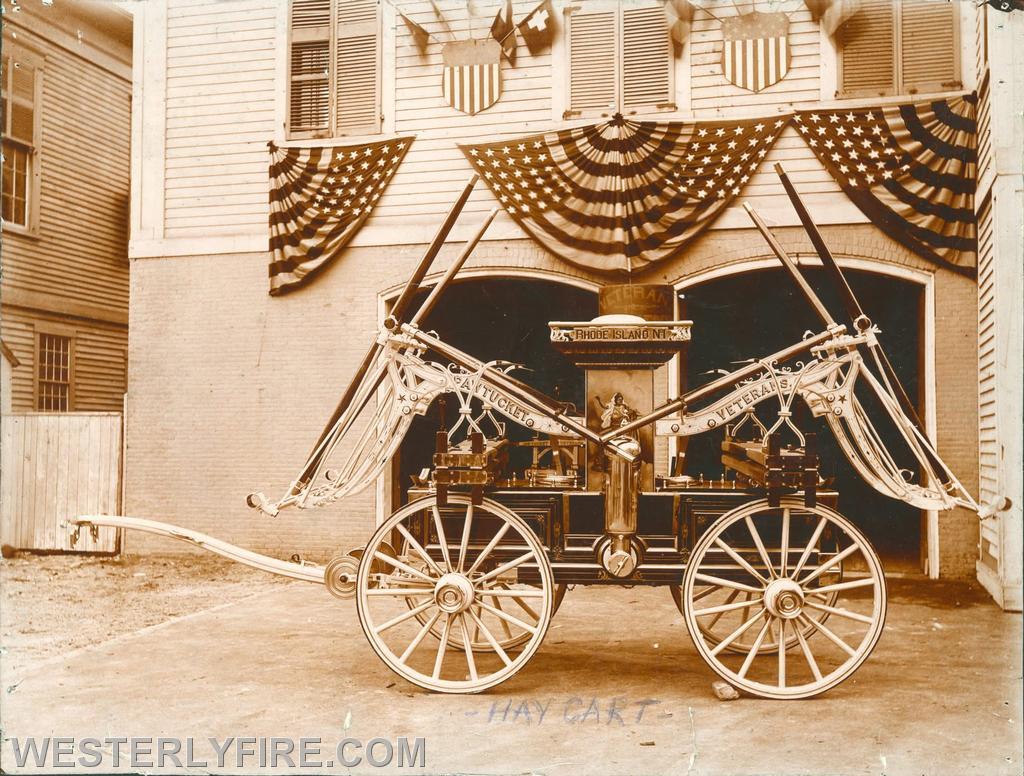
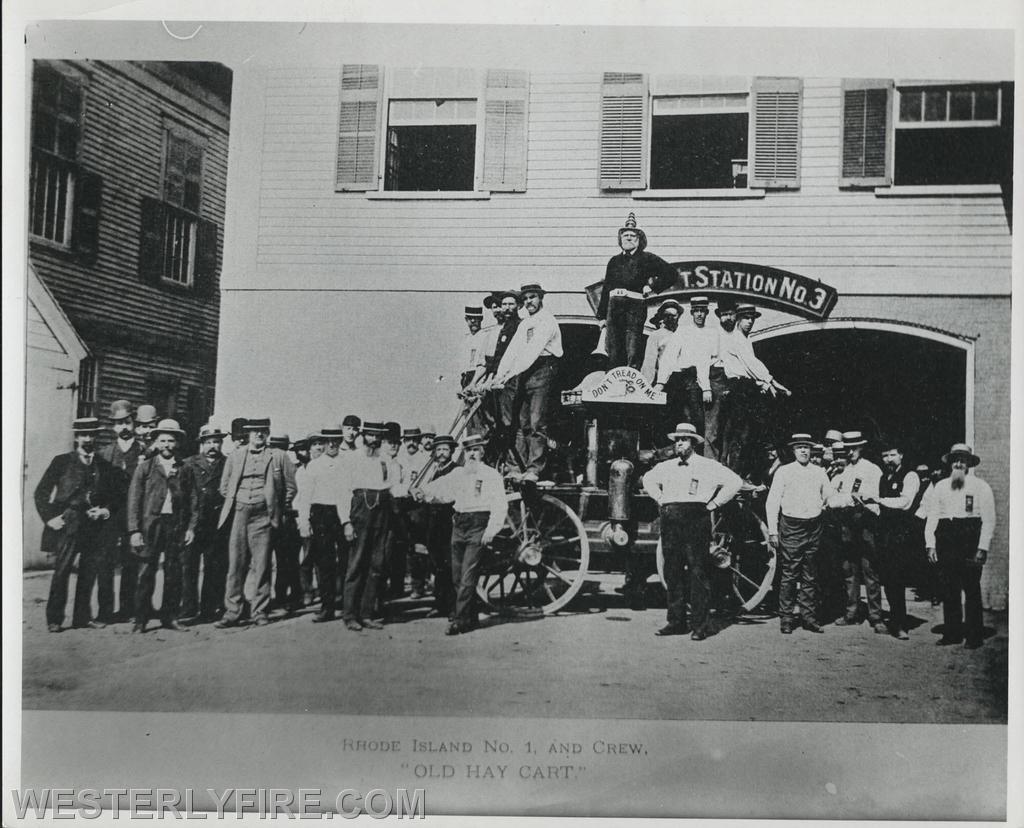
| The story of the Nathan F. Dixon, Jr. Engine Company No. 2 is a brief but vibrant chapter in the history of the Westerly Fire Department. Formed just a year after the district was established and disbanded five years later—eighteen years before the district brought back a second engine company in the form of the Cyclone Steam Fire Engine Company No. 2—the first Engine Company No. 2 was once a beloved fixture in town. Named after one of Westerly’s most prominent citizens, the company was famous for hosting grand balls and lavish dinners, as well as for its aggressive speed in getting water onto a fire. Known affectionately—and occasionally mockingly—as the “Hay Cart” or simply “The Twos,” the N. F. Dixon, Jr. Engine Company No. 2 remains a remarkable tale of local rivalry, social camaraderie, and incredible physical endurance.
The apparatus itself was built in 1849 by William Jeffers of Pawtucket for that city’s Rough and Ready Engine Company. A nine-inch, double-deck hand engine, it was a heavy-duty machine requiring a large team of muscular men to work its stacked handlebars. The pumper served Pawtucket for years before eventually being traded back to its maker.
By late 1868, the village of Westerly faced growing anxiety over its fire protection. A catastrophic fire at the Charles Maxson & Co. planing mill in October 1868 made town leaders realize that their existing infrastructure was drastically inadequate. In January 1869, a citizens' committee purchased two pieces of equipment from Jeffers: a modern, steam-powered fire engine dubbed the "Rhode Island Steam Fire Engine No. 1," and the veteran 1849 hand pumper.
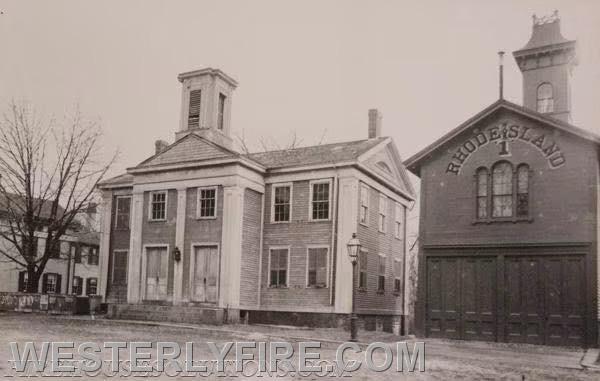
In early 1872, a new force emerged in Westerly's fire service. Approximately forty men—the majority of whom were seasoned veterans who had already fought blazes across town—banded together to formally organize a separate engine company around the hand engine maintained by "The Ones." Meeting in mid-March to elect officers and adopt a formal structure, the men officially named their outfit the "Nathan F. Dixon, Jr. Engine Company No. 2." Popularly known around town as "The Twos," the company quickly established itself as a spirited, close-knit, and formidable crew. Stationed in the downtown business district on Union Street near the Pawcatuck River—sharing an engine house with The Ones—their hall served as both the apparatus shed and the lively hub of their social life.
Warren W. Brown served as the first and only Foreman of Company No. 2. Born and raised in North Stonington, Connecticut, Brown enlisted in Company G of the 21st Connecticut Volunteer Infantry in 1862. During the Civil War, he saw extensive action at Fredericksburg, Drewry’s Bluff, and Cold Harbor, serving alongside Lieutenant Courtland G. Stanton, his cousin Abel Brown, and Edwin Lewis—all future Westerly firefighters. Following the war, Brown relocated to Westerly and went to work in the telegraph business. He joined the Rhode Island Steam Fire Engine Company No. 1 shortly after his arrival in 1866 and spent the next five years as a hoseman on Engine Company No. 1. When the Fire District established the new company in 1872, Brown was elected Foreman—a position he held every year until the unit was disbanded in 1877.
Operating the heavy hand pumper was a grueling physical task. It required dozens of men working double-deck brake handles in rapid, exhausting shifts to draw water from static sources like the Pawcatuck River or town cisterns and draft it through leather hose lines. The company regularly put the rig through rigorous trials after maintenance, frequently turning out in full uniform to test its performance around town.
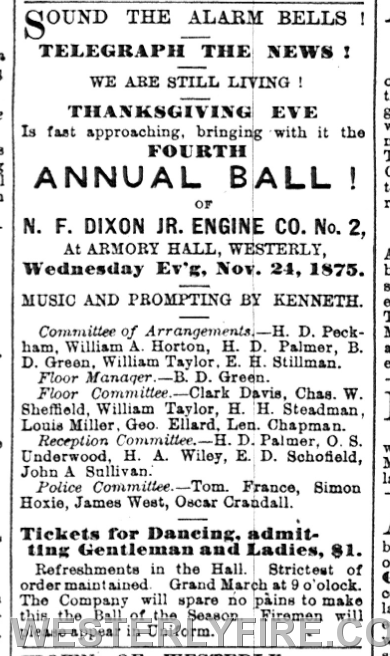
Beyond their fireground duties, Company No. 2 was celebrated for its vibrant camaraderie and high spirits, which were often documented with humor in the pages of the Narragansett Weekly (the predecessor to The Westerly Sun). Officers frequently hosted lavish suppers at the engine house for members and guests. At one notable gathering of seventy men, official business yielded to an informal call to "go for it," resulting in a feast large enough to feed a regiment. During that same event, Congressman Dixon himself joked that he was likely invited to speak because he was "more windy than any other person present," while expressing heartfelt pride in having his name attached to the company. The local press also tracked the friendly rivalry between The Ones and The Twos, playfully teasing the foremen after hunting trips and reporting on humorous incidents—such as the Assistant Foreman "rescuing" a full-grown rag doll from a chimney fire on Mechanic Street, which the company jokingly kept as a mascot and vowed to educate at its own expense.
Alongside these lighthearted moments, the company shared deep bonds of brotherhood during times of tragedy. Following the death of member Edwin P. Berry, Jr. in April 1873, the company adopted formal resolutions of sympathy, draped their engine house in mourning for thirty days, and attended his funeral in full uniform. These were the first documented displays of mourning as a department for a comrade who had died before his time. Both companies had Civil War veterans in their ranks, and their military experience in battle had surely begun to leave its mark. Leadership throughout these years remained remarkably stable under Foreman Warren W. Brown, alongside officers such as Oliver Davis, Hiram D. Palmer, Byron D. Green, Ned T. Hurd, Albert Taylor, and Abel Brown, supported by dozens of active hosemen.
Despite their dedication, the aging hand engine soon became a lightning rod for bitter local politics and social friction as steam technology advanced. Townspeople poked fun at its bulky, high-framed silhouette, remarking that it resembled an old hay cart. Meanwhile, a fierce operational rivalry erupted between the men of the modern steam engine (The Ones) and the hand-pumper crew (The Twos). Tensions escalated into legendary wet-down battles where firemen targeted each other's hats with high-pressure hose streams.
While the steam engine could generate higher pressure over longer periods, it required time to build up steam in its boiler. The hand engine, by contrast, could draft water immediately, routinely getting a stream onto a blaze long before the steamer was ready. The rivalry came to a head when the foremen of both companies made a high-stakes wager: a contest to see who could throw a stream of water the farthest, with the loser buying the winner a keg of beer. The Nathan F. Dixon, Jr. crew won the challenge when their stream cleared the top of the downtown Baptist church.
What had begun as a friendly contest only deepened the animosity between the crews. By 1877, the Rhode Island Steam Fire Engine Company No. 1 had had enough of the rivalry; sharing the firehouse had become too toxic. During a monthly meeting, Company No. 1 passed a resolution formally demanding that the Board of Engineers grant them sole possession of the shared Union Street firehouse, dissolve the Nathan F. Dixon, Jr. Engine Company No. 2, and turn over all of Company No. 2's equipment to them. They declared that if these demands were not met, every member of Engine Company No. 1 would resign from the department entirely.
This operational friction between the volunteer companies, paired with internal politics and the imminent arrival of a modern municipal water system, signaled the end of the hand-pumper era in Westerly. In February 1877, under increasing pressure, Chief William P. Coy and the fire district passed a formal resolution disbanding the Nathan F. Dixon, Jr. Engine Company No. 2, subsequently transferring all of its equipment to Engine Company No. 1.
The trusty "Hay Cart" was placed into storage until 1886. Members of Rhode Island Company No. 1 stripped all markings of the former company off the engine and replaced them with their own name. After sitting unused for years, the engine was sold at auction to E. R. Pendleton for just thirty-five dollars. It was later acquired by C. B. Cottrell & Co., who intended to break the machine down for scrap brass and metal ornaments. However, the old engine was saved from destruction when members of the Veteran Firemen's Association of Pawtucket caught wind of its fate. Recognizing the pumper’s historic legacy, they reclaimed the machine and brought it home to Pawtucket.
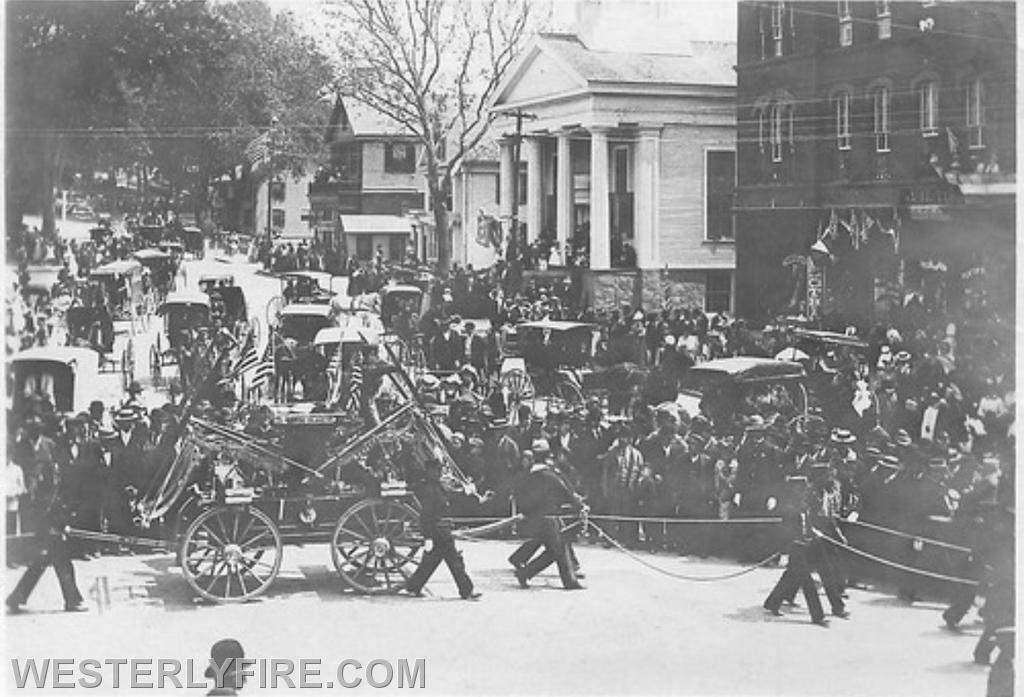
In Pawtucket, the once-mocked pumper was transformed into a legendary champion of New England muster competitions. Stripped down and tuned strictly for distance, the engine set astonishing records in high-stakes water-throwing contests. At a meet in Worcester, Massachusetts, the crew threw a stream of water 204 feet—even after a brake handle snapped mid-pump, forcing them to hold the apparatus together with a simple rope. Keeping the name "Rhode Island No. 1" on the hand engine, the crew went on to dominate meets in Fall River, Springfield, Providence, Lowell, and Charlestown, frequently capturing top honors against dozens of competing crews.
Back in Westerly, the old pumper's original brass nozzle vanished over the decades. Used in the legendary 1870s water battles, the historic nozzle was finally identified in the early 20th century, stored safely in the Peleg S. Barber hose house on Liberty Street.
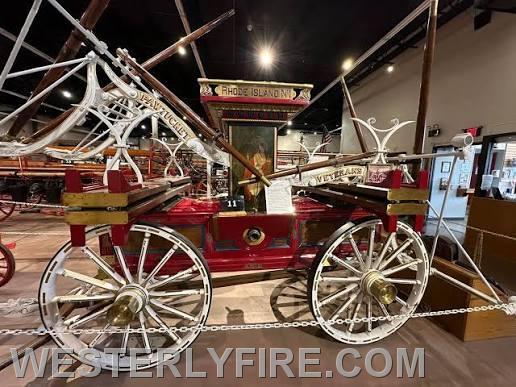
Though the disbandment of Company No. 2 in 1877 marked the end of an era for Westerly, the engine itself proved its worth long after its local retirement. Transformed from a ridiculed "hay cart" into one of the most famous competitive hand pumpers in New England history, the original N. F. Dixon, Jr. apparatus survives to this day—beautifully restored and displayed in an Arizona museum, painted in honor of the Pawtucket Veteran Firemen’s Association that saved it from the scrap heap. The history and legacy of the N. F. Dixon, Jr. Engine Company No. 2 carries on every time the bell tips for a run or when visitors see their engine on display. Though the men who manned the engine at fires and parades have long since passed, the engine—and the department they helped build—remains |